

Where Do All the Pipes Go? CMDB and CSDM in Plain English.
CMDB abnd CSDM in plain english, A friendly into.
Before I worked in IT, I was an urban planner. The first thing you learn about a city is that somebody has to know where all the pipes go. When nobody does, a broken water main turns into a very long day.
IT has the same problem, and ServiceNow has two answers to it: the CMDB and CSDM. Here’s how they look from a planner’s desk.
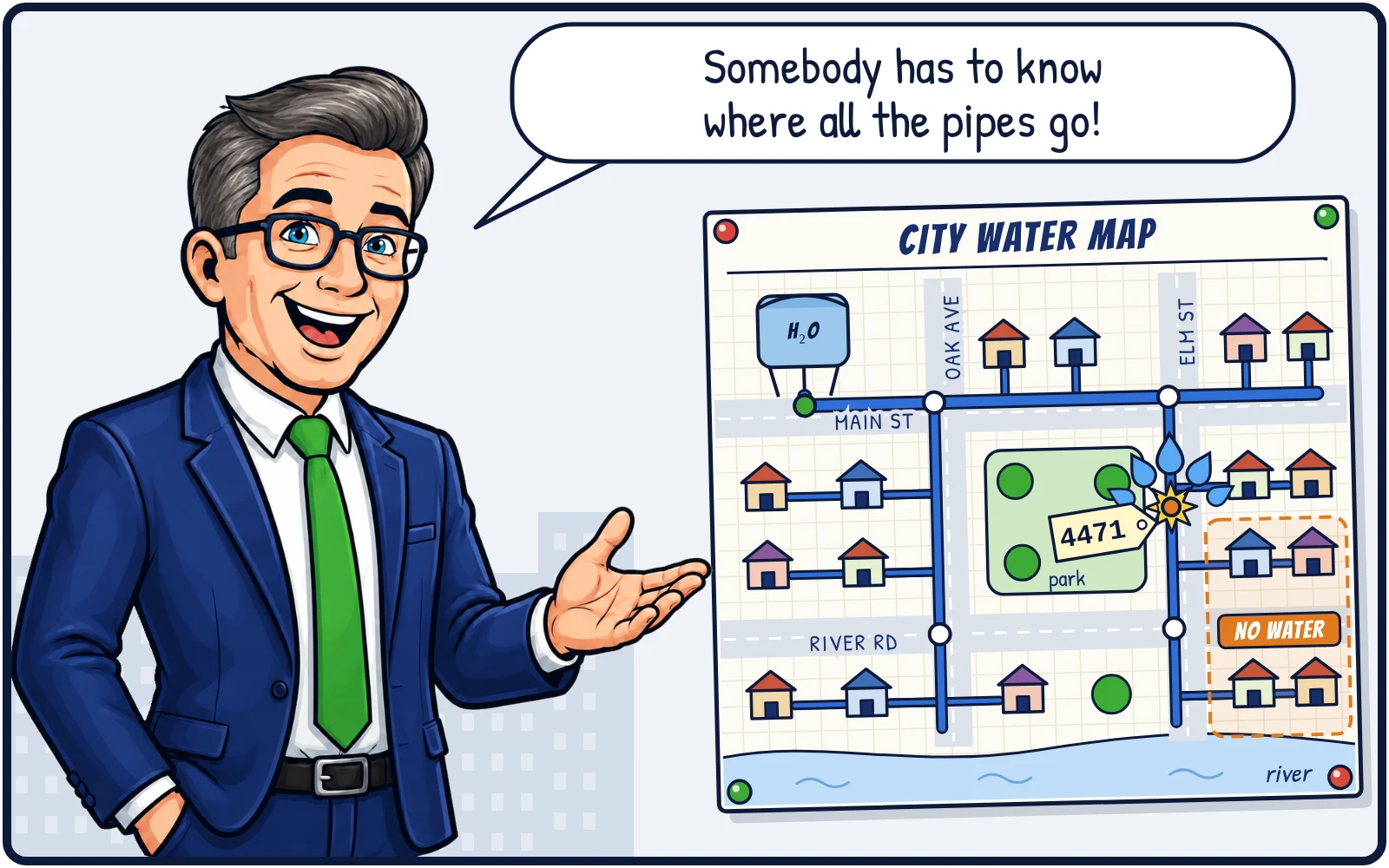
The CMDB: the city’s records
CMDB stands for Configuration Management Database. Think of it as the city records office. It keeps track of everything the city needs to keep running: buildings, roads, streetlights, power lines and water pipes.
In ServiceNow, each of those things is a configuration item, or CI for short. A server is a CI. So is a database, an application, a network switch or a cloud resource.
But here’s the part I love. A good city record doesn’t just list the pipes. It knows which pipe feeds which house. The CMDB does the same with relationships: this application runs on that server and depends on this database. When something breaks, relationships are how you work out who’s affected.
A record is only as good as its last update, though. A map of last year’s pipes sends the crew to the wrong street. Every record needs someone who owns it and keeps it current. That’s the unglamorous part of the job, and it decides whether anyone trusts the map.
CSDM: the city plan
Now picture a city with perfect records and no plan. Every street is called Main Street. Nobody agrees on what counts as a neighborhood. One office files the bus routes under “Transport,” another under “Wheels.” All the information is there, and nobody can find any of it. The problem isn’t missing data; it’s missing structure.
That’s where CSDM comes in. It stands for Common Service Data Model, and it’s ServiceNow’s city plan. It sets the zoning and the street names: where each kind of data belongs, what to call it, and how it connects to everything else.
Best of all, it connects the pipes to the things people care about. Residents don’t think about pipe number 4471. They think about running water. CSDM gives you building blocks for that: business services (what people actually use), application services (the running systems that deliver them), and the shared technology underneath, plus a standard way to link them all together.
Better together
A CMDB without CSDM is a giant, accurate pile of records that nobody can navigate. CSDM without a healthy CMDB is a beautiful zoning map of an empty field. You need both.
Put them together and that broken water main becomes a manageable afternoon. You know which neighborhoods lose water, which crew owns the repair and what to tell residents. In ServiceNow terms, that’s an incident tied to the right service, a clear picture of the impact, and changes you can plan with confidence.
That’s it for today’s stroll
You don’t need to memorize any of this. If you remember “the CMDB is the city’s records, CSDM is the city plan,” you’ve got the big picture.
In upcoming articles, we’ll walk the streets one at a time: what really counts as a CI, how relationships work, and how CSDM’s building blocks fit together. Bring comfortable shoes.
Until then, make the data make sense.
— CMDB Guy
Caricature by Claude
Spotted an error — a release, a field, a behaviour? Tell me at contact@cmdbguy.com and I will put it right.